1. Introduction: From Chatbots to Agents
We are currently witnessing a fundamental paradigm shift in artificial intelligence. For the past few years, we have interacted with “narrow” AI—standard Large Language Models (LLMs) that act as reactive assistants, waiting for a human to provide a prompt before they can generate a response. Today, we are moving toward AI Agents: autonomous systems designed to be proactive, goal-directed, and capable of operating across diverse software environments without constant hand-holding.
An AI agent is not just a smarter chatbot; it is a digital worker that perceives its environment, reasons through a strategy, and executes actions to achieve a specific objective.
AI Assistants vs. AI Agents
| Feature | AI Assistant (Traditional Chatbot) | AI Agent (Autonomous System) |
| Autonomy | Low; requires explicit human prompts for every single step. | High; can perform multi-step tasks and design its own workflow. |
| Triggers | Reactive; waits for a human to start a conversation. | Proactive; acts based on environmental changes, data triggers, or scheduled goals. |
| Reasoning | Linear; provides text based on training data. | Strategic; evaluates probable outcomes before choosing the best path. |
| Environment Interaction | Limited; typically lives and dies within a single chat window. | High; uses “Actuators” (MuleSoft/APIs) to interact with external software and CRMs. |
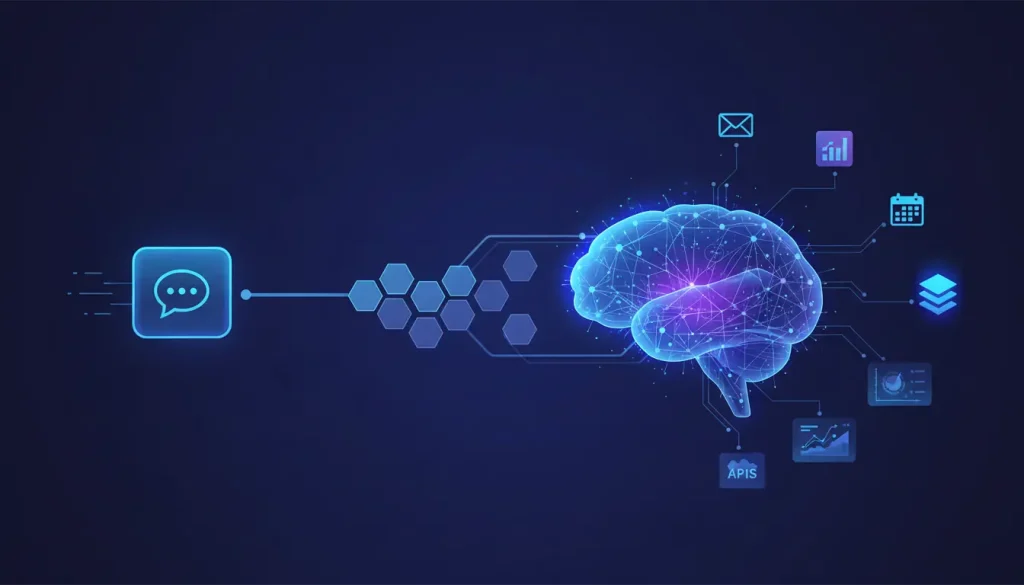
This shift from “helper” to “autonomous colleague” is made possible by a specific architectural loop—a digital brain that processes the world through four core components.
2. Component 1: Perception (The Digital Senses)
Perception is the interface between the agent and its environment. While humans use sight and sound, an agent uses Perception Mechanisms to ingest unstructured data (like emails, Slack messages, or PDF invoices) and translate them into something the brain can compute.
When an agent “perceives” a customer email, it isn’t just reading text; it is performing a process called Knowledge Representation. It takes a messy, human message and converts it into a digital “checklist” or structured internal format. This stage has three key outcomes:
- Interpreting Intent: Determining the core request (e.g., “This person wants a demo”).
- Extracting Entities: Identifying critical data points (e.g., Company name: Salesforce; Interest: Agentforce).
- Structured Representation: Mapping these details into a format the agent’s internal “brain” can use to plan the next step.
Once the agent has organized what it “sees,” it passes this structured data to the Strategy Engine to decide on a course of action.
3. Component 2: Reasoning (The Strategy Engine)
At the heart of an agent’s decision-making is a Reasoning Engine. This is where the agent performs Task Decomposition—the act of breaking a high-level goal (e.g., “Qualify this lead”) into a series of logical sub-tasks.
Unlike older software that follows a rigid IF-THEN script, agents use a “Model-Based” approach. This means the agent builds an internal model of the situation and evaluates probable outcomes before acting.
Logic over Rules: Traditional automation functions as a Simple Reflex Agent; it sees a trigger and blindly follows a rule. Modern agents are Goal-Based. They use logic to “vibe code” solutions on the fly, adjusting their plan if the environment changes or if a new piece of data makes the old plan obsolete. They don’t just follow a path; they choose the best path to the finish line.
After the agent creates its strategy, it must check its “folders” to ensure the plan matches the specific history and preferences of the user.
4. Component 3: Memory (Context and Continuity)
Memory is the anchor of autonomy. Without it, an agent would treat every interaction as if it were meeting you for the first time. To be truly autonomous, an agent must carry context through a long chain of actions.
AI agents utilize a sophisticated memory architecture to manage large amounts of history through Chunking and Chaining—breaking history into relevant bits and linking them for fast retrieval:
- Short-term / Working Memory (The “Post-it Note”): This tracks the immediate conversation. It ensures the agent remembers what the user said two minutes ago during the current task.
- Long-term / Episodic Memory (The “File Cabinet”): This stores past interactions, learned information, and user feedback over weeks or months. It allows an agent to know if a customer was frustrated in the past or if a lead prefers morning meetings.
The primary benefit is continuity. Memory prevents the agent from starting from scratch every time a task is initiated, allowing it to adapt to user expectations over time.
5. Component 4: Action (Execution and Tools)
Action is where the digital brain moves the physical world. While a chatbot can only speak, an agent can do. This is accomplished through Actuators—the digital “hands” of the agent that interact with other computer programs via tool-calling and APIs.
Agents don’t just generate text; they perform CRM Execution by connecting to specialized pipes like Salesforce Data Cloud or MuleSoft. This allows the agent to:
- Update a CRM: Automatically logging lead data or changing deal stages.
- Sync Tools: Checking a Google Calendar and booking a meeting slot.
- Communicate: Sending a follow-up email or a Slack alert to a human rep.
Permission‑Based Action: Agents do not act with total, unbridled freedom. They operate with specific entitlements, meaning they only use tools like your calendar or Salesforce data when they have explicit permission to do so.
6. Synthesis: The Complete Workflow in Motion
When these four components work together, they create a Learning Loop. The agent acts, observes the results, and uses that feedback to improve future reasoning.
Example: Booking a Meeting from a Lead Email
- Perception: The agent receives an email. It uses NLU (Natural Language Understanding) to create a Knowledge Representation: Customer X from Company Y wants a demo.
- Reasoning: The Atlas Engine evaluates the goal. It decides it needs to qualify the lead and find a meeting time. It decomposes the task into: 1. Check CRM, 2. Find open time, 3. Send email.
- Memory: The agent recalls from its “File Cabinet” that Company Y had a failed implementation last year. It adjusts its reasoning to draft a more empathetic, technical response.
- Action: The agent calls a MuleSoft API to check the calendar and sends a personalized link to the lead.
- Learning & Adaptation: The agent observes the “environmental feedback.” If the lead clicks the link and books the meeting, the agent logs this success, reinforcing that its empathetic tone was effective for this specific type of lead.
7. Summary: Why This Matters for the Future
AI agents represent the next step in scaling human effort. By understanding their anatomy, we can see how they move from being simple software to becoming “Digital Colleagues.”
- Scale Human Effort: Agents handle the “boring,” repetitive, rules-based parts of a workflow (data entry, scheduling, prospecting).
- Intelligent Adaptation: Unlike static code, agents use logic to navigate complex, changing business environments.
- Continuous Improvement: Through the learning loop, agents get better at their jobs the more they do them.
The Architect’s Stamp: While agents are masters of execution and logic, they are not replacements for people. Humans remain the masters of high-level strategy, human connection, and complex judgment. The agent serves as a force-multiplier, handling the “how” so that humans can focus on the “why.”
Ready to explore AI agents for your business? Contact us for a short discovery call.